






By Kenneth Christiane L. Basilio, Reporter
PHILIPPINE Vice-President Sara Duterte-Carpio’s decision to run for President in 2028 is unlikely to derail impeachment proceedings at the House of Representatives, a congressman said on Wednesday.
“It’s a strategic decision to strengthen her following, especially because there are impeachment complaints against her,” Senior Deputy Majority Leader and Iloilo Rep. Lorenz R. Defensor told reporters.
He said the complaints would likely move forward procedurally but might struggle to secure the required one-third vote in plenary needed to send the articles of impeachment to the Senate.
“As of right now, I cannot see getting one-third of endorsements from the members of the House of Representatives,” he said. “But I can tell you it will reach the Committee on Justice.”
He added that the complaints would likely be referred to the committee for determination of sufficiency in form and substance. “It will not affect how the process will go on in terms of hearing it, in terms of deliberations in the Committee on Justice,” he added.
Political analysts said the House is expected to proceed cautiously to avoid repeating missteps that led the Supreme Court to void earlier impeachment proceedings against Ms. Duterte.
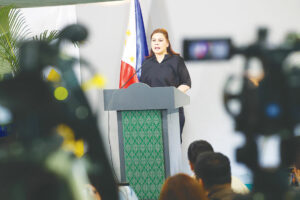
“The House has strong institutional incentives to demonstrate procedural rigor and constitutional fidelity,” Arjan P. Aguirre, an assistant political science professor at the Ateneo de Manila University, said in a Facebook Messenger chat before Ms. Duterte’s news briefing on Wednesday where she announced her presidential ambition.
A transparent process, he said, could help restore credibility after what some viewed as errors in the earlier impeachment attempt.
Ms. Duterte faces three impeachment complaints over the alleged misuse of P612.5 million in confidential and intelligence funds allocated to the Office of the Vice-President and the Department of Education when she served as secretary.
The complaints are expected to be referred to the House Justice Committee within the deadline set by the High Court after it nullified the previous proceedings. The tribunal ruled that the earlier impeachment did not comply with constitutional requirements, including the one-year bar rule.
“The defining factor in this impeachment is the Supreme Court decision,” Edmund S. Tayao, president and chief executive officer of Political Economic Elemental Researchers and Strategists, said via telephone. “It changes everything.”
Last year, more than one-third of lawmakers backed a fourth complaint that was sent directly to the Senate, effectively impeaching Ms. Duterte. Her trial was halted after the Supreme Court ruled the process unconstitutional.
Mr. Tayao said the ruling reshaped how impeachment is handled, stressing due process and clarifying how session days are counted. “The net effect of that decision is that impeachment is no longer mainly a political instrument,” he said. “It’s no longer just about numbers. They are now weighing the evidence.”
Batangas Rep. Gerville R. Luistro, who heads the Justice committee, earlier said the body would apply strict constitutional standards similar to those used in evaluating impeachment complaints against President Ferdinand R. Marcos, Jr., which were dismissed.
Mr. Aguirre said grounding the process in evidence and due process could reduce perceptions that impeachment is being used for partisan ends. He noted that documentary records tied to budget allocations could bolster the complaints against Ms. Duterte.
Ederson DT. Tapia, a political science professor at the University of Makati, said extended hearings could let lawmakers build a clearer factual record. “A long, drawn-out process allows for evidence-building, narrative framing and sustained public engagement,” he said via Messenger. “It creates space for institutional legitimacy rather than the perception of haste.”
He added that as political camps position themselves for 2028, impeachment carries electoral implications. “A process seen as vindictive could backfire. A process seen as transparent and evidence-driven could reinforce legitimacy.”
Ranjit Singh Rye, an OCTA Research fellow and assistant professor at the University of the Philippines, said prolonged scrutiny could affect Ms. Duterte’s standing as a presidential contender.
“Daily hearings, document disclosures, witness testimonies and sustained coverage can gradually affect how undecided voters view her viability,” he said in a Viber message.
“When a sitting Vice-President is not just viable but poll-leading, impeachment is no longer viewed purely as an accountability mechanism. It becomes a high-stakes political decision with presidential-cycle consequences,” he added.
Mr. Marcos is limited to a single six-year term and has yet to name a preferred successor, setting the stage for an extended contest as the next presidential cycle approaches.