










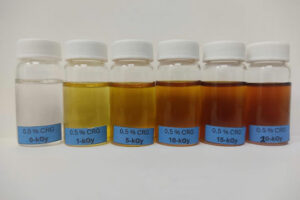
A group of scientists from the University of the Philippines (UP) has found a greener alternative method for producing silver nanoparticles, a material known for its antimicrobial properties, by using gamma radiation and a substance derived from seaweed.
Silver nanoparticles are extremely tiny particles of silver and are widely known for their antimicrobial properties, having been used in several applications such as medical use and clothing products.
However, producing them often requires strong reducing agents and stabilizers, which can be toxic, and disposing of them safely poses a challenge.
To solve this, scientists from UP-Diliman College of Science (UPD-CS) replaced these harsh chemicals with gamma radiation along with a natural seaweed-derived substance called carrageenan to create the nanoparticles.
“In simple terms, we let radiation do the “work” of forming the particles, while the seaweed extract keeps them stable and safe. We then tested how effective these particles are against common bacteria,” Mon Bryan Gili, one of the researchers from UPD-CS, said in a statement.
The method also sterilizes the nanoparticles as they form, making them ideal for medical use.
Mr. Gili noted that the groundbreaking method incorporates fewer processing steps and less chemical waste, and is safer for people and the environment, making it greener compared to traditional chemical methods.
Other UPD-CS researchers behind the greener approach to nanoparticles include Wendell Manuel, Dr. Marinette Vega, and Dr. Marlon Conato, as well as Rakshith Gowda Shankaregowda and Dr. Manh-Huong Phan of the University of South Florida.
UP said that the team’s concern for environmental safety and the growing issue of antibiotic resistance motivated them to explore alternative ways of producing silver nanoparticles.
Moving ahead, Mr. Gili said that they aim to improve the long-term stability of the produced nanoparticles and test them in real-world products, as well as assess their safety for human use.
“Ultimately, we hope this technology can lead to affordable, locally produced antibacterial materials using Philippine natural resources and nuclear science expertise,” he added.
The researchers detailed the approach in a study titled “Antibacterial evaluation of radiolytically synthesized silver nanoparticles with ι-carrageenan stabilizers.”It was published in the journal Radiation Physics and Chemistry, which covers research on ionizing radiation and its various applications. — Edg Adrian A. Eva