









By Chloe Mari A. Hufana, Reporter
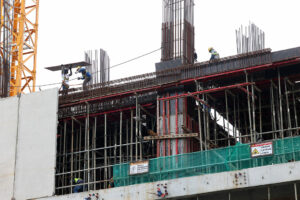
THE DEPARTMENT of Budget and Management (DBM) cut its infrastructure spending target to 4.3% of gross domestic product (GDP) this year from 5.1% previously, as a corruption scandal weighed on government spending and economic growth last year.
The lower target translates to about P1.3 trillion in infrastructure outlays, Acting Budget Secretary Rolando U. Toledo said on Tuesday, signaling a more cautious spending stance as the government works to restore confidence and streamline disbursements.
“Based on our approved General Appropriations Act, we’re looking at achieving our infrastructure target as [a percentage of our] GDP at 4.3%, and even at a nominal level, that is equivalent to P1.3 trillion,” he told a Palace briefing in mixed English and Filipino.
Infrastructure spending has been a key pillar of President Ferdinand R. Marcos, Jr.’s growth strategy, though execution slowed last year due to budget adjustments and project bottlenecks amid a massive graft scandal involving flood control projects.
The government had earlier set a target of 5.1% of GDP for infrastructure spending in 2026, equivalent to P1.56 trillion, lower than the 2025 target of 5.3% of GDP or P1.51 trillion.
In 2024, infrastructure spending accounted for 5.8% of GDP or P1.545 trillion.
Mr. Toledo said the government is still determined to boost investments in infrastructure in the medium term.
He said there is little risk of delays in infrastructure projects this year, after a “clean” budget process.
“There is no reason for us to delay,” Mr. Toledo said, adding that the 2026 national budget contains no “ghost projects” and that allocations across programs are fully specified, supporting the government’s ability to meet its infrastructure goals.
Mr. Marcos on Jan. 5 signed a record P6.793-trillion national budget amid a graft scandal, which has prompted tighter scrutiny of public spending and a more cautious approach to the release of funds for infrastructure and other major projects.
John Paolo R. Rivera, a senior research fellow at the Philippine Institute for Development Studies, said slower public works spending may temper economic momentum because infrastructure has one of the highest multiplier effects in the economy.
“It may cap growth momentum, as public works have one of the highest multiplier effects in the economy,” he said via Viber.
“The more cautious stance may help restore governance credibility, but it also means less crowding-in of private investment, weaker job creation in construction and allied sectors, and slower productivity gains,” he added.
Economy Secretary Arsenio M. Balisacan last week said economic growth in the Philippines likely eased to between 4.8% and 5% in 2025, reflecting the impact of the graft scandal on the economy.
The Philippine Statistics Authority is set to publish official fourth-quarter and full-year 2025 GDP figures on Jan. 29.
Without faster execution, improved project selection, or stronger private investment to offset the slowdown, the Philippines’ economic growth could fall short of its potential even as confidence gradually improves, Mr. Rivera said.
Michael L. Ricafort, chief economist at Rizal Commercial Banking Corp., said higher government spending — particularly on infrastructure — is likely to be the primary driver of economic growth in 2026.
He expects authorities to accelerate public works as early as the first quarter to make up for underspending last year, which he said was partly due to tighter anti-corruption measures and governance reforms.
A catch-up spending program could help bolster investor confidence and sentiment, Mr. Ricafort said, reinforcing the growth outlook.
He said prospective interest rate cuts by the US Federal Reserve and the Bangko Sentral ng Pilipinas would lower borrowing costs, supporting credit demand, investment and overall economic expansion.