









1 of 2
A NUMBER of gowns belonging to a well-loved former first lady are on display at the Magsaysay Laureate Library and Museum at the Magsaysay Center.
The exhibit, titled Magsaysay as Muse: Luz Banson Magsaysay and the Terno as Cultural Identity is presented by the Ramon Magsaysay Award Foundation (RMAF) in cooperation with the De La Salle – College of St. Benilde (DLS-CSB) through the Benilde Fashion Museum (this serves as its inaugural exhibit).
The exhibit runs from Feb. 12 to March 27.
THE MAGSAYSAYSMrs. Magsaysay began life as the daughter of the wealthy Banzon family (aside from land holdings, they also owned a transportation company). It was in her parents’ dealings in the transportation industry that she would meet her husband, the future seventh president of the Philippines, Ramon Magsaysay. The legend of Mr. Magsaysay’s common touch with the people started here, where he worked as a mechanic and a shop superintendent.
They married in 1933, and saw out the Second World War together, when Mr. Magsaysay found his first taste of leadership in the guerrilla forces against the Japanese. Mr. Magsaysay ran for Congress after the war, then was appointed to government posts (he was also secretary of National Defense).
Mr. Magsaysay won the presidency in 1953, and was remembered for land reform, his solution to the Hukbalahap rebellion, and encouraging closer ties with Southeast Asian neighbors — not to mention bringing the office of the president closer to the people. Sadly, few people remember this life, overshadowed by his sudden death in a plane crash in 1957.
Mrs. Magsaysay, according to her grandson, Br. Mike Valenzuela FSC, in an interview during the exhibit’s opening on Feb. 12, “wanted to vanish from the public eye after my grandfather died.” He pointed out that not many people knew she still lived, until her death was reported in 2004.
THE WOMAN IN THE DRESSBehind the dignity of office though, her grandson Mr. Valenzuela remembers a different woman: one who talked to reformed assassins, drank a beer every night for health reasons, and had tuyo (dried fish) for breakfast.
Asked if he remembers his grandmother as particularly fashionable, he told BusinessWorld, “How do I say it? She knew what quality was. She respected it. But she was not one to run (after it)… it did not obsess her in any way.”
A white Ramon Valera terno in the exhibit, he pointed out, was worn by her several times at the Ramon Magsaysay Awards ceremonies. Meanwhile, a poignant terno stands out: one not made of the fine silks she wore in office. She wore it during the campaign, with her husband’s face and slogan (“Magsaysay is my Guy”) emblazoned on the sleeves. Mr. Torres says that it had a tag: “Lina’s,” possibly an off-the-rack or made-to-order item from a lesser-known designer.
“She was very simple,” Mr. Valenzuela recalled, and, vanishing from the public eye in her widowhood, “she became a recluse.”
“She wasn’t one to collect,” he said about the gowns donated by his mother. “She didn’t have that much money in the first place,” he added. “She actually lived with an insecurity about money,” he said. It is a credit to her husband’s legacy then, that several people pitched in to help after his death: a grand house she lived in after the Malacañang years, for example, was a gift from the Ortigas family. “When my grandfather died, the goodwill was so great that everyone wanted to support her.”
“One thing I remember is, whenever she goes out in public, she was always dressed,” he said. “For her, she believed that even though my grandfather died, she was carrying his legacy.”
He recounted a story that every Sunday, Mrs. Magsaysay visited her husband’s grave, and almost always saw another man there. “She was always very gracious with anyone who came, rich or poor,” he said. “Befriending him, she found out that he was one of the rebels her husband had pardoned — he had been an assassin — yet they chatted like old friends,” he said. “My grandmother had a gift: she could talk to anyone. She never thought of herself as a grand person.”
THE TERNOS
Gerry Torres, Benilde Fashion Museum’s director and the exhibit’s curator, took guests around the library to show Mrs. Magsaysay’s ternos. They show a distinctly postwar silhouette, closer to its final form than the traje de mestiza of the 19th century that it came from.
The traje de mestiza was a complete ensemble that included a panuelo (a fichu), a skirt, and a camison (a blouse) with pagoda sleeves. Later changes in fashion melded these elements into one by the postwar period, with the sleeves rising to become half-moons (popularly called the butterfly sleeve).
Mr. Torres, during his tour, credited this change to the popularity of the zipper. While the zipper was invented earlier, one of the first few designers to use it was Elsa Schiaparelli, and it only achieved mainstream fame after the war (perhaps after seeing it used efficiently in military gear).
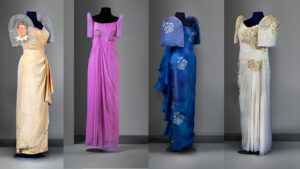
Eight ternos are on exhibit: seven of them come from a bequest by her daughter, Milagros Magsaysay, while one is from the archives of the RMAF.
One of the earliest ternos in the collection was a white one by Ramon Valera, the first National Artist for Fashion Design in the Philippines. Mr. Torres pointed out the mastery in draping, almost like that seen in classical Greek marbles, and the intact beadwork.
Another dress showed the rising pan-Asian identity in a shimmering olive green, an early Thai silk, decorated with gold bands.
One blue terno had a sash running through grommets at the bustline.
One notes Mrs. Magsaysay’s age through the dresses: as a young, energetic first lady in the 1950s, her ternos are cinched at the waist. “It helped a lot that she had a slender figure, which made her ideal for most fashion designers,” said Mr. Torres in a speech, estimating that Mrs. Magsaysay might have had a 25-inch waist.
After Ramon Valera’s death in 1972, she switched her patronage to Aureo Alonzo (who died in 2014). The vicissitudes of fashion and her own age prompted Mr. Alonzo to lift the bodice up from her waist to her bustline (turning her silhouette into the then-fashionable empire waist).
According to Mr. Torres, Mrs. Magsaysay was one of the most prominent figures in the 1950s to wear the terno, as the country’s first lady. He credits this enthusiasm for native dress to postwar and post-independence nationalism, pointing out that her husband was the first Filipino president to wear the barong Tagalog at his inauguration.
“I believe that she was also trying to echo what her husband, President Ramon Magsaysay wanted to say: that we are going to rebuild our country after the war. Part of it was to establish identity as a nation, and as a people.”
CONSERVATIONOne terno, in a deep blue silk organdy and embroidered with silver flowers — and unfortunately damaged — prompted Mr. Torres into a discussion of the difficulties of displaying clothing in a museum.
There’s the problem of proper dress forms, for example: the ones available commercially are much too large to accommodate the smaller ladies of the past, and they have to be padded and custom-fit to specifications of the past, according to him.
Secondly, the dress forms themselves kill the dress. “When you put a compromised garment vertically on a mannequin, it actually adds to the stress of the clothes,” he said.
He cited an exhibit at New York’s Metropolitan Museum of Art’s Costume Institute called Sleeping Beauties, where heavily damaged garments were laid to “rest” for the exhibit, laid flat to reduce stress on the clothes — a possible solution for the future museum. That’s one of the reasons for the exhibit’s short life – it only runs for about six weeks. “You cannot exhibit clothing for too long,” Mr. Torres said during the tour. “You have to keep it for twice the time that you (bring) it out.”
The Benilde Fashion Museum, currently still in construction at the former Mayflower Apartments, the old Instituto Cervantes building, on Leon Guinto St., corner Estrada in Malate, Manila, is yet to have a firm opening date, Mr. Torres told BusinessWorld. But he said it is slated to open this year, hoping to show a sampling of the museum’s collection by the last quarter of this year.
Among the collections to be included in the museum are gowns used by another first lady, Leonila Garcia (wife of President Carlos P. Garcia), and gowns from the collection of murdered socialite and TV host Elvira Manahan. The gowns are meant to be studied by the students in Benilde’s fashion design and merchandising program — and the rest of the country. “We hope to show them to our students, for them to study, and perhaps they could get inspiration from what they see,” said Mr. Torres.
“We are cultivating the next generation of fashion designers.”
The Magsaysay exhibit will be accompanied by talks: “The Lady Behind the Terno” about Mrs. Magsaysay’s life on Feb. 19, a talk about the Benilde Fashion Museum’s conservation efforts on Feb. 26, and one about Ramon Valera on March 26, all at 2 to 4 p.m. at the Magsaysay Center. The Magsaysay Center is at the corner of Roxas Blvd. and Quintos St. in Malate, Manila. — Joseph L. Garcia