








By Justine Irish D. Tabile, Senior Reporter
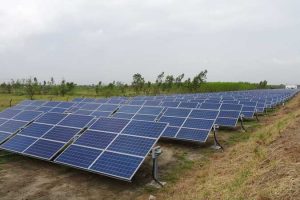
THE reduced investment approvals target for the Board of Investments (BoI) for 2026 reflects a slowdown in the renewable energy (RE) segment after a number of contracts were reviewed.
John Paolo R. Rivera, senior research fellow at the Philippine Institute for Development Studies (PIDS), said: “Over the past few years, large-scale RE projects, especially solar and wind, significantly boosted total approvals because of their capital-intensive nature,” he told BusinessWorld.
“With some contracts under review or revoked and the pipeline recalibrated, approvals are now expected to be driven more by mineral processing, infrastructure, and high-value manufacturing, which typically involve smaller project sizes but potentially stronger value-added and employment effects,” he added.
He said the lower investment approval target does not reflect weaker investor interest in the Philippines but rather “a normalization in project composition and a shift toward more strategic, industry-focused investments.”
In January, the Department of Energy (DoE) said 163 terminated and relinquished service contracts since 2024 accounted for nearly 18,000 megawatts worth of potential capacity.
These contracts consisted of hydro, solar, wind, geothermal, and biomass projects that had been awarded via green energy auctions (GEAs).
The Department of Trade and Industry (DTI) said on Saturday that it set a P1-trillion target for BoI investment approvals this year.
This is lower than the P1.56 trillion worth of investment pledges approved in 2025. The BoI expats approvals to be driven by mineral processing, infrastructure, and high-value manufacturing projects.
“As these typically have lower investment costs per project than RE, we are therefore targeting lower BoI registrations this year,” the DTI said.
For 2026, Trade Undersecretary and BoI Managing Head Ceferino S. Rodolfo said the government expects the investment picture to reflect the benefits of various investment-related reforms.
“The biggest driver of investments is not promotions in a marketing sense but policy reform,” he told BusinessWorld.
“We have seen this in RE, with the surge of investments following the lifting of foreign equity caps on RE projects, or with telecommunications, with the issuance of policy on shared telco towers,” he added.
He said the focus in 2026 will be on mining and mineral processing, digital infrastructure, tourism, and high-value manufacturing.
The government expects to reap benefits from the Enhanced Fiscal Regime for Large-Scale Metallic Mining Act, the conclusion of the critical minerals agreement with the US, and the Konektadong Pinoy Act.
The BoI also expects to see results from the visa-free entry policy for key source markets, full implementation of the value-added tax refund for tourists, and the implementation of a Semiconductor Industry Roadmap, among others.
Rizal Commercial Banking Corp. Chief Economist Michael L. Ricafort said the corruption scandal of 2025 remains a risk clouding the investment picture.
“For the coming months, improved governance standards and reforms will help improve investor confidence and sentiment, could lead to a pickup in investment,” he said via Viber, citing as a prerequisite the effectiveness of anti-corruption measures and other reforms related to further improving governance standards.
Meanwhile, exporters said it might be possible to achieve the export target set by the DTI assuming no changes in the Trump tariffs.
“I think we might even exceed it because in 2025, surprisingly, we made something like $135 billion,” Philippine Exporters Confederation, Inc. President Sergio R. Ortiz-Luis, Jr. said via telephone.
“Unless there are surprises from Trump, I think it will be easy to beat the upper-end target set by the DTI,” he added.
He said that the main export drivers this year are the electronics, agricultural products, minerals and mining products, and tourism.
Meanwhile, exporters are on the lookout for US tariffs on electronics and agricultural products.
For 2026, the DTI said it expects total exports — consisting of merchandise and services — to range between $116 billion and $120 billion, in line with the Philippine Development Plan (PDP).
“We expect electronics, information technology and business process management (IT-BPM), and key food exports such as coconut, banana, and pineapple products to continue driving growth,” the DTI said.
“At the same time, we are working to develop new export winners,” it added, noting that hopes are being pinned on garments, footwear, travel goods, personal care, and unique Filipino flavors such as ube.
Bianca Pearl R. Sykimte, director of the DTI-Export Marketing Bureau, said that electronics remain the backbone of Philippine merchandise exports.
“In 2025, electronic products accounted for nearly $50 billion, representing more than half of total exports and growing by 16% year on year,” she said via Viber.
“This momentum is expected to continue in 2026, especially since Philippine semiconductor exports were not covered or affected by recent Section 232 tariffs imposed by the US on semiconductors,” she added.
She said electronics, along with IT-BPM and food exports, showcase the broadening of the export base.
“In addition, projected increases in export‑oriented investments by Investment Promotion Agencies (IPAs) are expected to further widen Philippine capabilities,” she added.
Foreign Buyers Association of the Philippines (FOBAP) President Robert M. Young said that it might be hard to achieve the DTI export target.
“The very reason, I think, that they are having these very ambitious numbers is due to merchandise export, which rose 15%,” he said by telephone.
“They must understand that the reason behind this was because the whole Philippine export industry got rattled … they rushed the production (to front-load shipments before the US tariffs took effect),” he added.
However, he said the same rate of export growth cannot be expected for 2026.
“For Thailand, Malaysia, and Cambodia (the rates are) zero, and the Philippines is still at 19%,” he said.
“We will have a hard time competing on price because these are the guys are our direct competitors,” he added.
For the garments sector, he said that the industry is now expecting exports to be flat this year.
“We will only be plateauing, so it will not increase … We think reality will bite in 2026 due to factors such as the number of free trade agreements of the Philippines compared to other neighboring economies,” he added.