








By Justine Irish D. Tabile, Senior Reporter
OUTSOURCED semiconductor assembly and test firm ASE Co., Ltd. is planning a 26,000-square-meter (sqm) expansion in the Philippines, the Philippine Economic Zone Authority (PEZA) said on Wednesday, underscoring continued investor interest in the country’s electronics and semiconductor sector.
“This is a high-tech company,” PEZA Director-General Tereso O. Panga told BusinessWorld via Viber. “It is the biggest outsourced semiconductor assembly and test company in the world… There are big prospects for their planned expansion in the Philippines.”
“We are also partnering with them on electronics manufacturing services and semiconductor manufacturing service workforce development, as well as artificial intelligence and machine learning,” he added.
Headquartered in Kaohsiung, Taiwan, ASE has been operating in the Philippines for three decades and employs about 825 workers.
The company makes electronic and semiconductor products, with investments worth billions of pesos, PEZA said.
In a social media post, PEZA said the company outlined a “strong growth trajectory” anchored on its planned 26,000-sqm expansion.
The project is expected to generate more jobs, raise export output, deploy advanced manufacturing technologies and strengthen linkages within the local semiconductor supply chain, the investment promotion agency said.
ASE’s Philippine facility is located at the Gateway Business Park Special Economic Zone in General Trias, Cavite province. The company traces its roots to 1994, when it began operations as Cypress Semiconductor Philippines.
PEZA said the expansion reflects sustained confidence by ASE’s Taiwan-based parent group in the country’s manufacturing ecosystem and long-term investment prospects.
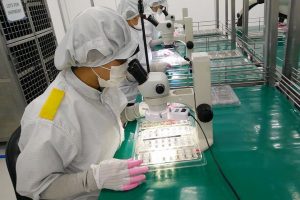
During a visit to the plant on Jan. 22, PEZA officials were briefed on the company’s Autoline-enabled manufacturing platforms, which allow a 24-hour turnaround time. These systems support product validation, rapid fault isolation and high-reliability assurance.
These capabilities “strengthen ASE’s role as a critical semiconductor manufacturing and service hub for Internet of Things, automotive, industrial and other high-reliability applications,” PEZA said.
The company has also established the ASE Institute, which aims to provide intensive entry-level training for engineering roles to help meet the growing demand for skilled and future-ready talent in the semiconductor industry.
Mr. Panga said ASE has been invited to participate in the PEZA AI Academy by integrating its internal training programs into the academy’s curriculum.
“We want to pursue an industry-wide approach to human resource development for our PEZA-registered business enterprises,” he said.
“Strong linkages with universities and colleges are crucial in strengthening the supply chain and sustaining high-technology industries,” he added.
John Paolo R. Rivera, a senior research fellow at the Philippine Institute for Development Studies, said the expansion suggests that major investors are willing to deepen their presence in the country despite global and domestic uncertainties.
“Such expansions help validate the country as a viable destination for higher-value, export-oriented projects and can generate jobs, boost supply chain activity and attract related investments,” he said in a Viber message.
He added that better policies and business confidence can offset short-term challenges, showing that the country’s long-term fundamentals remain strong.
Michael L. Ricafort, chief economist at Rizal Commercial Banking Corp., said the announcement sends a positive signal to investors despite recent political and governance issues.
“This sends a good signal on investor confidence and sentiment on the country, transcending political noise,” he said, citing favorable demographics and economic fundamentals.
However, he said the Philippines should continue easing regulatory bottlenecks and lowering the cost of doing business to draw more foreign direct investment.
“These will create jobs and business opportunities that will further support inclusive and sustainable economic growth over the long term,” he added.
PEZA said it expects to approve about P300 billion worth of investment pledges this year, up 15% from 2025.