





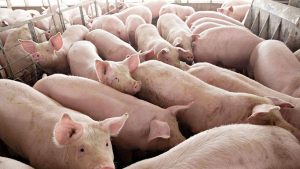


HOG RAISERS want the government to restore higher pork tariffs, warning that a surge in imports has oversupplied the market and dragged down farmgate prices.
Alfred Ng, vice-chairman of the National Federation of Hog Farmers, said the group is pushing to raise pork tariffs back to 40%, arguing that lower duties have outlived their purpose and are now hurting local producers.
Lower tariff rates were introduced in 2021 to stabilize pork prices after African swine fever disrupted domestic supply. Since then, tariffs have remained at 15% for in-quota imports and 25% for out-of-quota shipments.
“Tariffs are supposed to protect local farmers from unfair trade and the dumping of subsidized agricultural products,” Mr. Ng said in a Viber message. “The reductions were meant to be temporary, but they have remained in place even as import volumes surged.”
Pork imports rose about 16% last year, or roughly 120 million kilos, bringing total shipments to more than 850 million kilos. Mr. Ng said these volumes are unprecedented and have weighed heavily on local prices.
He said live hog prices began falling in June last year and failed to recover during the usual peak months of December and January, when demand typically lifts prices.
“For the first time in more than 30 years of hog farming, liveweight prices did not improve in December and continued to decline in January,” he said.
Data from the Philippine Statistics Authority showed that average liveweight hog prices in the fourth quarter fell 14% to P182.83 per kilo, from a year-high average of P212.54 per kilo in the first quarter.
In response to the sharp drop, the Department of Agriculture agreed in November to raise the floor price for live hogs to P210 per kilo after prices sank to as low as P150 per kilo, close to production cost.
Despite the weakness at the farm level, Mr. Ng said retail pork prices in wet markets remained elevated, even as the landed cost of imported pork fell to about P120 per kilo.
“This clearly shows that consumers are not benefiting from importation,” he said. “Instead, local farmers are bearing the cost, while importers are capturing the margins.
Mr. Ng also raised concerns over food safety, saying frozen imported pork has entered wet markets and been sold as thawed meat, competing directly with locally produced pork.
He said this practice violates agriculture regulations that prohibit the display and sale of thawed frozen meat without proper chilling equipment.
Continued overimportation could undermine the Department of Agriculture’s multibillion-peso hog repopulation program, Mr. Ng said, as low prices and the risk of African swine fever discourage farmers, especially small producers, from raising hogs.
Aside from restoring higher tariffs, hog raisers are calling for tighter controls on pork import volumes to cover only supply shortfalls, as well as stronger border inspections.
These measures would help keep unsafe and smuggled meat out of the market and protect both farmers and consumers, he added. — Vonn Andrei E. Villamiel