









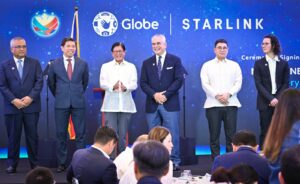
GLOBE TELECOM, Inc. has partnered with Elon Musk’s Starlink to bring its direct-to-cell satellite services in the Philippines, making the country the first in Southeast Asia to offer the technology.
“By leveraging Starlink’s low earth orbit satellites, we will bridge coverage gaps in what we called geographically isolated and disadvantaged areas, enabling Filipinos to access essential services,” Globe President and Chief Executive Officer Carl Raymond R. Cruz said during the signing of a memorandum of agreement for the partnership.
The technology is targeted to be commercially available by end March, Mr. Cruz said, adding that the company is working to lower the pricing of the services to make it more inclusive.
Starlink’s direct-to-cell technology connects users directly to its low-earth orbit (LEO) satellite, which provides text, voice, and data connectivity to users particularly in remote areas which lack coverage.
This landmark initiative is part of the Ayala-led telecommunications company’s commitment to ramp up its investment in technologies to help bridge the digital and connectivity gap in the Philippines.
At present, Globe said that it has achieved about 97% coverage in the country, and the balance 3%, which are considered underserved, can take advantage of the new technology being offered.
Information and Communications Technology Secretary Henry Rhoel R. Aguda said the agency is confident that the new technology will spur growth of the digital economy as this will enhance connectivity in the country.
Starlink’s direct-to-cell service is a satellite-to-mobile wireless technology launched by its parent company Space Exploration Technologies Corp. (SpaceX).
Although Globe is the first telecommunications company in the country to bring Starlink’s direct-to-cell services, Starlink has also inked a partnership with Converge ICT Solutions, Inc., making it an authorized reseller of Starlink kits in the Philippines.
Starlink continues to expand its satellite network to provide high-speed broadband to rural and remote areas, according to its website.— Ashley Erika O. Jose