








By Katherine K. Chan and Aaron Michael C. Sy, Reporters
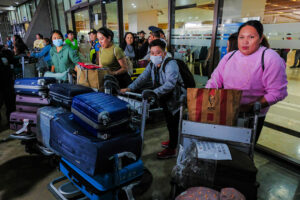
OVERSEAS Filipino workers’ (OFW) remittances are expected to remain stable this year despite the United States’ move to charge a 1% tax on cash transfers to foreign countries, analysts said.
Analysts see the new duty having a muted impact on remittance growth in the Philippines.
“The proposed 1% tax on OFW remittances in the US could be a drag, though minimal or negligible, on OFW remittances growth and on the overall local economy,” Rizal Commercial Banking Corp. Chief Economist Michael L. Ricafort told BusinessWorld in a Viber message.
On Jan. 1, the US government began to impose a 1% tax on remittances from US-based senders, regardless of citizenship status, made via cash payments, money orders and cashier’s checks.
However, the regulation exempts money wired via US banks or US-issued debit and credit cards, as well as hand-carried cash.
Union Bank of the Philippines Chief Economist Ruben Carlo O. Asuncion noted that steady global demand for Filipino workers and better labor conditions in major host countries should support continued growth in remittances this year.
“Regarding the newly implemented 1% US remittance tax, its macroeconomic impact is likely minimal, as it applies only to cash-based transfers while digital and bank channels remain exempt,” he added via Viber.
Mr. Ricafort estimated the Philippines may lose around P8 billion to P9 billion annually due to the tax, although noted that remittances could still grow by around 3% this year.
“About 3% OFW remittances growth (is) still possible for 2026 since the 1% tax would be relatively affordable for many OFWs in the US,” he said.
A 1% tax means the US government gets a dollar for every $100 remitted from the US to other countries.
In October, Filipinos abroad sent home $3.171 billion, up 3% year on year from $3.079 billion, latest data from the Bangko Sentral ng Pilipinas (BSP) showed.
This was the slowest growth since May when remittances rose by 2.9% but matched the 3% growth in July.
The US remained the top source of remittances to the country in the first 10 months of the year, accounting for 40.3% of total remittances during the period.
“The new US remittance tax will put mild pressure on the peso in the short term as inflows dip slightly,” Reyes Tacandong & Co. Senior Adviser Jonathan L. Ravelas likewise said in a Viber message.
Philippine Institute for Development Studies Senior Research Fellow John Paolo R. Rivera said in a Viber message that the new remittance tax could slightly dampen support for the peso as the US is a major source of inflows.
“In the near term, any impact on the Philippine peso is likely to be modest, as remittances are relatively resilient and driven more by labor demand and migrant incomes than taxes alone. For the medium to long term, the effect will depend on whether tax meaningfully changes remittance behavior,” Mr. Rivera said.
In addition to reduced inflows, Mr. Rivera said the added tax could weaken key buffers for the local unit as it could encourage the use of informal channels.
Meanwhile, a trader said OFWs would likely adapt by sending more money home to offset the tax costs.
“Since there will be 1% excise tax, there will be changes in behavior. But if the remittances are intended for their families, I think the remittances will adjust rather than result (in) a reduction,” the trader said in a Viber message.
“Those in the US who will send money here will just work harder to compensate for the excise tax rather than send something smaller,” the trader added.
Mr. Asuncion also noted that the levy might drive OFWs to switch from traditional or physical remittance service providers to digital platforms to cut costs.
“(I)t could influence remittance practices by encouraging OFWs to shift toward formal, digital platforms to avoid additional costs, potentially reducing reliance on informal channels and improving financial inclusion,” he said. “While some households may adjust transfer frequency or consolidate remittances to manage costs, overall inflows should remain broadly stable.”
In the long term, Mr. Ravelas said the peso could be kept broadly stable by OFWs’ shift to cheaper digital channels to send money home.
He said this could prompt policymakers to strengthen monitoring and promote low-cost formal channels.
BDO Capital & Investment Corp., President Eduardo V. Francisco said he is hopeful the additional tax would not dampen remittances, given that the bulk of remittances sent to the Philippines are for families.
“I guess we have to see if the remittance businesses will just absorb the new excise tax or pass it to their customers. I hope it is not the latter,” he said in a Viber message.
The BSP projects cash remittances to grow by 3% to $36.6 billion this year.