








By Chloe Mari A. Hufana, Reporter
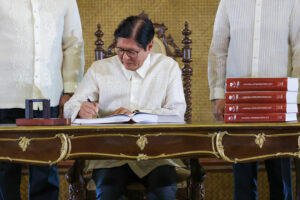
PHILIPPINE President Ferdinand R. Marcos, Jr. on Monday signed this year’s P6.793-trillion national budget but vetoed around P92 billion worth of unprogrammed appropriations amid heightened scrutiny over public spending as authorities probe a graft scandal.
During the signing of Republic Act No. 12314 or the 2026 General Appropriations Act in Malacañang, Mr. Marcos said the veto aims to ensure public funds are spent strictly in line with national priorities.
“To ensure that public funds are expended in clear service of national interests, I vetoed several items of appropriations with their purposes in corresponding special conditions under the unprogrammed appropriations totaling almost P92.5 billion,” he said.
He ordered government agencies to exercise prudent fiscal management while ensuring uninterrupted public service.
Unprogrammed appropriations are meant to give the government flexibility in responding to emergencies or unforeseen needs. However, their use has drawn closer scrutiny amid concerns that excessive or unclear releases could weaken fiscal oversight and accountability.
After the veto, the total unprogrammed appropriations were reduced to the “absolute bare minimum” or about P150 billion from P243 billion in the General Appropriations Bill.
The President said this is the lowest level of unprogrammed appropriations since 2019 and stressed that releases would undergo careful validation.
“My administration will enforce these safeguards without exception, to serve the public interest and to advance our national development goals,” he said.
The Department of Budget and Management (DBM) said the veto underscored the administration’s commitment to fiscal responsibility.
Acting Budget Secretary Rolando U. Toledo said the Executive thoroughly reviewed this year’s budget to ensure it is consistent with state priorities while taking into account stakeholder recommendations.
VETOED ITEMSAt a separate press briefing, Executive Secretary Ralph G. Recto detailed the vetoed items, including budgetary support for government-owned and -controlled corporations worth about P6.9 billion, fiscal support for the Comprehensive Automotive Resurgence Strategy (CARS) amounting to P4.32 billion, and P2 billion allocated for insurance of government assets.
In a statement, the Board of Investments (BoI) Managing Head Ceferino S. Rodolfo said the agency respects the decision of the President to veto the funds for the CARS program.
“We firmly assure that we are already working with other agencies, principally the DBM, in identifying a mechanism to ensure payment of CARS arrearages especially as these had been based on validated delivery of performance commitments and on a robust and transparent inter-agency process of vetting claims against the CARS program,” Mr. Rodolfo said.
Other items struck from the 2026 budget included P80 billion for the Strengthening Assistance for Government Infrastructure and Social Programs (SAGIP), P6.7 billion in public health emergency benefits, P2 billion for compensation of Marawi siege victims, and P210 million for the Nampedai property.
Also vetoed were smaller allocations that covered local government shares from prior years, payments related to personnel services already lodged in agency budgets, and government counterpart funding for certain foreign-assisted projects, Mr. Recto said.
After the veto, only three items remained under the unprogrammed appropriations: P97.3 billion to support foreign-assisted projects, P50 billion for the revised Armed Forces of the Philippines modernization program, and P3.6 billion for a risk management program.
The remaining unprogrammed fund totals about P150.9 billion, roughly in line with levels last seen in 2019, Mr. Recto added.
The country began 2026 under a reenacted budget until Jan. 4 after delays in the bicameral conference committee deliberations late last year. Congress only ratified the budget bill on Dec. 29, 2025.
Mr. Marcos said expenditures lawfully incurred during the reenacted period would be considered by the Budget department in formulating fund releases for the year.
‘CLEANEST EVER’Senate President Vicente C. Sotto III called this year’s budget the “cleanest ever,” pertaining to the cutback of unprogrammed funds.
‘It seems the President wants it squeaky clean,” he told reporters via Viber. “He even highlighted the Senate provision that prevents political patronage by politicians.”
House Speaker Faustino G. Dy III pledged strict congressional oversight to ensure funds are spent legally, efficiently and without corruption.
Senate Committee on Finance Chair Sherwin T. Gatchalian said the chamber had already removed the P80 billion SAGIP allocation from the 2026 national budget, underscoring that the fund had long been viewed as a source of abuse and corruption.
In a statement, Mr. Gatchalian said that SAGIP — lodged under unprogrammed appropriations — was eliminated by the Senate.
He said there were no direct vetoes affecting programmed appropriations and that five of the seven items vetoed under the unprogrammed appropriations were originally part of the National Expenditure Program submitted by the Executive branch, which Congress merely reviewed and refined.
He also clarified that the inclusion of the Revitalizing the Automotive Industry for Competitiveness Enhancement program in the unprogrammed appropriations was for book-entry purposes only, similar to the CARS program. The item does not involve the release of cash but serves as legal authority for the Department of Trade and Industry’s BoI to issue tax payment certificates.
Meanwhile, Gary G. Ador Dionisio, dean of the De La Salle-College of St. Benilde’s School of Diplomacy and Governance, said the 2026 budget provides a measure of stability and continuity for the government amid global economic uncertainty and domestic challenges, reflecting Mr. Marcos’ commitment to ensure the uninterrupted delivery of services, ongoing projects and support programs.
‘The remaining P150 billion [in unprogrammed funds] should be guarded with great caution in order to avoid wasteful expenses including possible corruption of funds,” he said via Facebook Messenger.
“We can’t afford a reenacted budget, in the same manner that we can’t afford to experience another round of huge incidents of corruption.”
BIGGEST ALLOCATIONSEducation received the biggest allocation at P1.015 trillion, equivalent to 4.36% of economic output, meeting the benchmark under the United Nations Educational, Scientific and Cultural Organization’s Education 2030 framework, according to the DBM.
The budget provides for almost 33,000 teaching positions, more than 32,000 nonteaching posts, and funding for about 25,000 classrooms.
The increased funding comes as Filipino learners grapple with a literacy crisis and lag behind their regional peers.
The Department of Public Works and Highways (DPWH) will receive P530.9 billion for 2026 amid the corruption scandal involving flood control projects, making it the second top-funded government agency. However, this is 40% lower than the original proposal of P881 billion.
Mr. Toledo said the budget retained funding for flood control projects but was limited only to those covered by foreign-assisted programs, or about P15.7 billion.
The funding will allow the government to continue implementing projects already under contract and ensure they proceed according to approved plans, Mr. Toledo said.
Health spending increased to P448.1 billion to support universal healthcare, including zero-balance billing, disease surveillance, and the hiring of more health workers. The allocation is also expected to strengthen the Philippine Health Insurance Corp.
The Department of National Defense and the Department of Interior and Local Government will receive P310 billion each.
The Agriculture department will get P297.1 billion to boost food security and productivity, while the Social Welfare department’s budget reaches P270.2 billion. The budget also includes P15.33 billion for disaster rehabilitation and reconstruction, and higher spending for military and uniformed personnel after the pay adjustments set to take effect this year.
The Transportation department will receive P141 billion, while the Labor department will get P73.6 billion, and the Judiciary will receive P70.6 billion. — with Justine Irish D. Tabile