










TROPICAL CYCLONES that make landfall in the Philippines pose different risks, with faster storms threatening the Visayas and Mindanao (VisMin) and stronger but slower cyclones affecting Luzon, a University of the Philippines (UP) study found.
“Storms that hit the northern part of the country tend to be stronger but slower-moving. Southern storms tend to be faster and accelerate more rapidly,” Bernard Alan B. Racoma, assistant professor at the UP Diliman College of Science’s Institute of Environmental Science and Meteorology, was quoted as saying in a statement. “This has implications on the kinds of hazards these storms may bring.”
Mr. Racoma, together with Gerry Bagtasa, analyzed 372 tropical cyclones from 1979 to 2024, identifying patterns in storm speed, intensity, and duration.
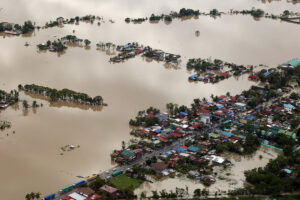
The study found that fast-moving and rapidly accelerating storms in the Visayas and Mindanao leave residents with limited time to prepare, while slower but more intense cyclones in Luzon increase the risk of prolonged flooding and landslides due to extended rainfall.
Despite tropical cyclones often remaining within the Philippine area of responsibility (PAR) for several days, the researchers said that their direct presence along Philippine coastlines is short, averaging only about 21 hours before moving inland or away.
Mr. Racoma said the country’s narrow east-west geography partly explains this. In terms of geography, the Philippines is relatively narrow: it stretches more from north to south than from east to west. “Since tropical cyclones usually move from east to west, they tend to cross this shorter path faster,” he said in a mix of English and Filipino.
He added that storms also weaken over land as they lose access to warm ocean waters that fuel them.
The researchers said timing and intensity evolution are critical factors in reducing disaster risk, particularly given the threat of rapid intensification.
“Rapid intensification occurs very fast — typically within 24 hours. We don’t yet fully understand it; even weak storms can intensify quickly,” Mr. Racoma said.
He also warned against delaying preparations until a storm strengthens, noting that about half of tropical cyclones that form or enter the PAR make landfall, with rapid intensification commonly occurring within the region. — Vonn Andrei E. Villamiel