





THE WORLD BANK (WB) sees a gradual recovery for the Philippines in 2026 and 2027, after growth slowed this year due to weaker investment and sluggish consumption, compounded by a corruption scandal and a string of natural disasters.
In its latest Philippines Economic Update released on Tuesday, the multilateral lender trimmed its Philippine gross domestic product (GDP) growth forecast to 5.1% for this year from 5.3% in its June report.
For 2026, it lowered its Philippine GDP growth forecast to 5.3% from 5.4% previously.
The World Bank also cut its Philippine GDP growth projection for 2027 to 5.4% from 5.5% previously.
These latest projections are below the government’s 5.5-6.5% growth goal for this year and the 6-7% target for 2026 to 2028.
“To borrow from Torsten Slok, chief economist at Apollo (Management), it’s a Nike swoosh pattern. He describes the US economy, and I’m describing our forecast for the Philippines as a kind of Nike swoosh. We have a dip in 2025, and then we have a gradual recovery in 2026 to 2027,” World Bank Senior Economist Jaffar Al-Rikabi said during a briefing.
He noted the average growth of the Philippines over 2025 to 2027 will be lower than 2024 when GDP expanded by 5.7%.
“For 2025… the growth is largely weighed down by domestic factors. In particular, lower construction activity and weaker consumption growth,” he said.
The Philippine economy expanded by a weaker-than-expected 4% in the third quarter, bringing nine-month growth to 5%, as the pace of household final consumption expenditure and government spending slowed amid a corruption scandal.
Mr. Al-Rikabi also noted the deceleration in fixed investment and private consumption due to higher-than-expected number of natural disasters that hit the Philippines this year.
“But for 2026 to 2027, we think that it’s likely that external factors will weigh more heavily on growth, largely slower export demand,” Mr. Al-Rikabi said.
The US imposed a 19% tariff on most goods from the Philippines starting August, dampening export demand.
The World Bank said the Philippine economy’s growth will pick up in 2026 and 2027, fueled by strong domestic demand.
“Private consumption is projected to strengthen as inflation stays low, employment remains robust, and monetary easing lowers interest rates, making it easier for businesses and households to borrow,” it said in the report.
According to the World Bank, private consumption, which accounts for more than 70% of the economy, is projected to expand by 4.8% this year, slowing from 4.9% in 2024. This is expected to pick up to 5.3% in 2026 and 5.4% in 2027.
The World Bank said investment is likely to recover as public infrastructure projects regain momentum, while recent liberalization reforms in telecommunications, transport, logistics and renewable energy improve the business climate.
The multilateral lender also expects headline inflation to average 1.8% this year, describing the pace as “very moderate” and a key source of resilience. This forecast is slightly above the Bangko Sentral ng Pilipinas’ (BSP) 1.7% projection for 2025 and the 1.6% average recorded in the first 11 months.
‘CORRUPTION IS UNACCEPTABLE’Even as the Philippine economy will see a gradual recovery in the next two years, Mr. Al-Rikabi noted risks are tilted to the downside, with “more prominent” domestic drivers.
“There is a continued challenge of heightened perceptions around governance risks. This could, if it continues, erode investor confidence. It could delay public investment execution, and it could weaken growth,” he said.
The World Bank economist also noted there may be delays in fiscal and structural reforms amid the current domestic environment, “which could slow consolidation and weigh on growth over the medium term.”
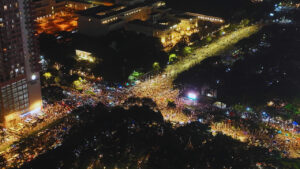
A corruption scandal involving anomalous flood control projects has already triggered protests, slowed economic activity, and shaken investor confidence in the country.
“From the World Bank perspective, corruption is unacceptable,” World Bank Country Director for the Philippines, Malaysia, and Brunei Zafer Mustafaoğlu said during the same briefing.
“The World Bank considers it detrimental to any country and has been fighting against corruption in all the member countries that we operate in,” he added.
Mr. Mustafaoğlu said the Philippine government could take this opportunity to increase transparency and modernize its budget execution system “that could actually support longer-term growth and can increase investment confidence (and) can increase long-term potential growth,” he said.
Mr. Al-Rikabi said it is important that the Philippine government double down on governance and institutional reforms. The government should also continue fiscal reforms to ensure “fiscal consolidation continues on a credible path that doesn’t compromise long-term growth.”
Also Mr. Al-Rikabi said adverse climate events remain a source for risk for the Philippines, as it could disrupt food supply and drive prices higher.
On external risks, the World Bank cited policy uncertainty, which could weaken investment trading confidence, disruptive financial market corrections, and weaker growth in key partner countries.
He also noted that as investments in artificial intelligence normalize, major economies could face sharper deceleration, which would weigh on Philippine exports and industry.
Mr. Al-Rikabi said the government should ensure structural reforms, which opened up some sectors to more foreign investments, are implemented effectively.
UPPER MIDDLE-INCOME STATUSMeanwhile, Mr. Al-Rikabi said the Philippine gross national income (GNI) per capita has managed to reach the upper middle-income country (UMIC) status threshold in 2025.
“Our 2025 projection already implies that the Philippines will reach in terms of GNI per capita the threshold for UMIC this year,” he said.
According to the World Bank’s last country income classification, the Philippines is still a lower middle-income country with a GNI per capita of $4,470 in 2024. It was only $26 shy of the World Bank’s adjusted GNI per capita requirement of $4,496-$13,935 for UMIC status.
However, Mr. Al-Rikabi said that the World Bank has to see three years of GNI per capita above the threshold to formally reclassify a country as UMIC.
“That implies as long as the economy continues to grow in 2026-2027, the country would be reclassified as UMIC in 2028,” he said.
The Washington-based lender will release its new country status thresholds in July 2026. — A.R.A. Inosante