








By Kenneth Christiane L. Basilio, Reporter
PROTEST ORGANIZERS should turn the multibillion-peso flood control scandal into a central campaign issue for the 2028 elections, political analysts said, arguing that an early push could help shape voter sentiment and boost anti-corruption candidates.
They also said organizers should start “blacklisting” politicians linked to the controversy to weaken support for officials tainted by the scheme.
“The issue is existential and must pivot towards 2028,” Hansley A. Juliano, a political science lecturer at Ateneo de Manila University, said in a Facebook Messenger chat. “If genuine and organic leaders spring on the local and national levels… [then there] is an opportunity to front with fresher, less compromised leaders.”
The call comes as corruption allegations deepen against President Ferdinand R. Marcos, Jr.’s administration less than three years before the next presidential vote. His slipping public approval could complicate efforts to rally voters behind his preferred successors.
Mr. Marcos’ satisfaction score fell to its lowest since he took office in 2022, according to a WR Numero Research poll released last week. About 21% of Filipinos approved of his performance in November, down 14 points from August.
The Philippines is confronting one of the biggest political crises of Mr. Marcos’ term, as lawmakers, officials and contractors face accusations of taking part in a kickback scheme that drained billions of pesos from flood mitigation funds.
Activists should “initiate a blacklist movement against those involved in corrupt practices,” said Anthony Lawrence A. Borja, an associate political science professor at De La Salle University. “If it’s effective, then such a movement can prevent implicated politicians from occupying public offices while serving as a warning for the elected.”
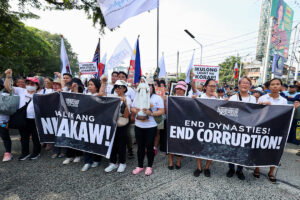
The widening scandal has triggered protests nationwide, especially in flood-prone provinces. The largest rallies have been held in the capital region, led by left-leaning groups and a coalition of church leaders and civil society organizations that accuse the government of failing to safeguard public funds.
Still, analysts said the movement needs to fix internal divisions to build a broader coalition.
Activists should “deal with their own disunity” to create a more cohesive anti-corruption front, Mr. Borja said. “This would allow them to attract more moderate citizens who share the same concerns.”
Public sentiment appears to favor the demonstrations. WR Numero Research said last week that 58% of Filipinos supported the Nov. 30 protests denouncing irregular flood control deals. About 18% opposed them, while two in 10 were unsure.
“The gap suggests that while only a minority are intensely mobilized, a much larger moral majority still stands behind the cause,” Cleve V. Arguelles, chief executive officer of WR Numero Research, said in a Viber message.
“It means support for the anti-corruption protests is both deep and wide, even if not everyone can join street actions,” he added.
Protest leaders also need a sharper message to expand their reach, said Ederson DT. Tapia, a public administration professor at the University of Makati.
“People will join a movement when they see how flood control corruption translates into the everyday misery of flooded streets, lost income and disrupted schooling,” he said via Messenger chat. “Organizers must make that link clearer so more sectors feel compelled to step in.”
Mr. Borja said organizers should keep the pressure up against the government to hold those liable to account.
“They should always remind the public on who are the ones involved in faulty flood control projects and establish a coalition that is focused on demanding accountability and free from elite politicking,” he said.
“Sustaining attention also requires discipline,” Mr. Tapia said. “A steady flow of updates, local monitoring, and well-timed public briefings tied to budget debates or audit releases can keep pressure alive long after the headlines fade.”
“The real test is whether this energy becomes reform,” he added, noting that independent oversight over public works contracts and making government bidding processes more transparent should be an objective for the protest movement.