





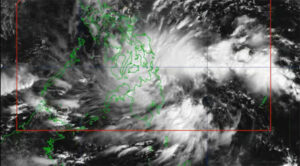
NATURAL DISASTERS such as typhoons that bring flooding and landslides pose minimal and temporary risks to the Philippines’ economic growth, Capital Economics said.
Senior Asia economist Gareth Leather cited the example of 2013’s Typhoon Haiyan, known in the Philippines as Yolanda, which killed 10,000 people but had a limited impact on economic growth.
“The floods that struck (this year) amid a corruption scandal centered on flood control projects, which could amplify public frustration and prompt a stronger government response,” Mr. Leather said in a note dated Dec. 3.
“Overall, however, while supply chains and manufacturing may face some disruption, the hit to activity is likely to be small and temporary,” he added.
Economy Secretary Arsenio M. Balisacan has said that the recent slowdown in household spending may be attributed to widespread cancellations of school, work, and travel activities due to the typhoons.
In the third quarter, growth in household final consumption expenditure, which accounts for over 70% of the economy, slowed to 4.1% from 5.3% a quarter earlier and 5.2% a year earlier.
This was the weakest reading since the 4.8% contraction in the first quarter of 2021.
Mr. Leather said typhoons mostly impact the agriculture sector, often causing food prices to spike.
In November, Typhoons Kalmaegi (Tino), Fung-Wong (Uwan), and Koto (Verbena) brought heavy rains and flooding across the country.
Agricultural damage from Kalmaegi and Fung-Wong topped P4.13 billion, while Verbena left P57.53 million worth of farm damage, the Department of Agriculture (DA) reported.
“This creates an upside risk to our inflation forecasts. The good news is that inflation is starting from a very low base — it is at or below target across most of the region,” Mr. Leather said.
In October, headline inflation settled at 1.7%, the eighth straight month that inflation came in below the Bangko Sentral ng Pilipinas’ (BSP) 2-4% target band. Ten-month inflation averaged 1.7%.
A BusinessWorld poll of 15 analysts yielded a median estimate of 1.6% for November inflation, slowing from 1.7% in October and 2.5% a year earlier.
Mr. Leather said the central bank thus has room to ease policy rates further.
BSP Governor Eli M. Remolona, Jr. said on Wednesday that the likelihood for another interest rate cut this month has increased, partly due to expectations that the economy will grow 4-5% this year, missing the 5.5-6.5% government target band.
The central bank has so far lowered borrowing costs by a total of 175 bps since it began its easing cycle in August 2024, bringing the benchmark interest rate to 4.75%.
The Monetary Board will convene for its last policy meeting of the year on Dec. 11. — Katherine K. Chan