









By Ashley Erika O. Jose, Reporter
THE PHILIPPINES’ digital economy is set to hit $36 billion in gross merchandise value (GMV) this year, supported by rapid adoption of e-commerce, transport and delivery services, digital finance and artificial intelligence (AI), according to a report by Google, Temasek Holdings and Bain & Company.
“The Philippines is a digital powerhouse, sustaining its double-digit growth and firmly on track to hit $36 billion in GMV by 2025,” Google Philippines Country Manager Prep B. Palacios told a news briefing on Tuesday.
“This momentum is not a temporary spike; it’s a sustained, systemic transformation, a convergence of innovative platforms, a tech-positive regulatory environment and our uniquely AI-curious Filipino consumers with real spending power,” he added.
The report projected that the country’s overall digital economy could reach $70 billion to $140 billion in GMV by 2030, slightly lower than last year’s forecast of $80 billion to $150 billion.
E-commerce alone is expected to contribute $50 billion, while transport and food services could hit $7 billion, online travel $8 billion and online media another $8 billion by the end of the decade.
Digital payments will remain a key growth driver, with digital financial services projected to expand to $200 billion to $300 billion in gross transaction value (GTV) by 2030, according to the report. Across Southeast Asia, the digital economy is expected to surpass $300 billion in GMV by the end of the decade, fueled by continued digital adoption and monetization strategies.
Charles Benedict Aquino, a partner at Bain, highlighted the resilience of the Filipino market. “The Philippines has shown itself to be resilient, that is the key message we are really seeing,” he told the briefing.
This year, the country’s e-commerce sector is expected to reach $24 billion, up 20% from last year. Online travel is projected to grow 33% to $4 billion, while online media will hit $5 billion and transport and food services $4 billion.
Ronald B. Gustilo, national campaigner for Digital Pinoys, said strong performance across these sectors reflects growing trust in digital platforms among both consumers and businesses.
“The Philippines’ digital economy continues to expand, driven by strong growth in e-commerce, transport and delivery services, and the rapid adoption of digital financial tools,” he said in a Viber message. –
Experts noted that the growth potential remains particularly strong in rural and underserved areas as mobile and data connectivity improves. “Logistics will be a requirement and also a growing business,” Michael L. Ricafort, chief economist at Rizal Commercial Banking Corp., said via Viber.
John Paolo R. Rivera, a senior research fellow at the Philippine Institute for Development Studies, said infrastructure gaps, cyberthreats, uneven logistics, regulatory uncertainty and low digital literacy among small businesses could slow digital adoption.
“Overall, growth prospects remain strong, but the digital ecosystem needs better safeguards, faster infrastructure rollout and more support for small businesses to fully realize its potential,” he said.
Cybersecurity was flagged as a pressing concern. Mr. Gustilo warned that phishing and AI-enabled scams could undermine consumer confidence and slow adoption, urging both the government and industry to treat cybersecurity as critical infrastructure.
“Protecting Filipinos online is essential if we want the country’s digital economy to reach its full potential,” he added.
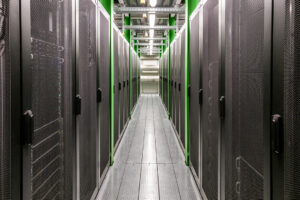
The Department of Information and Communications Technology (DICT) seeks to increase the digital economy’s share of the economy to 12.5% by 2028, fast-tracking digital infrastructure projects and attracting hyperscalers to operate in the country. Data center capacity is projected to reach 1.5 gigawatts by 2028, supported by both foreign and domestic operators.
The digital economy contributed 8.5% of GDP in 2024, little changed from 8.6% in 2023, though it remains below the 2021 peak of 9.2%. Bain’s Mr. Aquino noted that expansion of the digital economy depends in part on continued growth in data center capacity and robust digital infrastructure rollout.